
Identify the substrate and condition
Prepare the surface using the relevant Hempel instructions. Remove contamination and loose material, and make sure it is clean and dry.



Hempel's Light Primer is a two-component high-performance epoxy primer and undercoat for use both above and below the waterline. Use on glass fibre, wood, steel and aluminium. Superb corrosion, impact and water resistance. Use before Ocean Gloss/PolyGloss/Brilliant Gloss top coat for a long-lasting solution. Can also be used for osmosis protection when the application is required at low temperatures.
*Colours are for reference only and may appear differently once painted
Hempel Light Primer. Prepare for the finish with a two-component epoxy primer and undercoat. Light Primer helps protect against corrosion and osmotic blistering, with uses above and below the waterline.
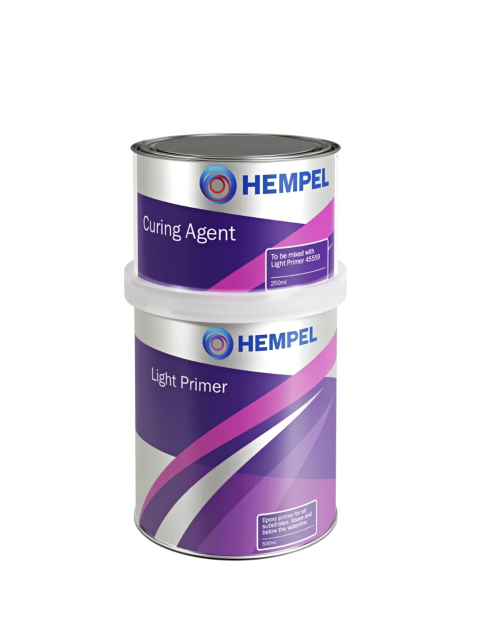
For glass fibre, steel, aluminium and plywood in the specified system.
Suitable for interior and exterior work, including keels and rudders.
Choose the required film build and coat count for the job.
Light Primer is a solvent-based epoxy primer for marine preparation and protection. Within a Silic One installation it is one possible foundation before the tiecoat; it also has wider priming and undercoating uses. Required film build depends on the surface and purpose, so a single coat should not be assumed to provide a full barrier system.
Prepare the surface using the relevant Hempel instructions. Remove contamination and loose material, and make sure it is clean and dry.
Mix base 45559 and curing agent 95360 at 2:1 by volume. Mix only what can be applied within the working time.
The reference coverage is 8.2 m²/L at 60µm dry film thickness. A different specified thickness changes coverage, curing and overcoating intervals.
Use the current product data, safety data and substrate-specific application instructions supplied by Hempel. Temperature, humidity and film thickness affect the working and overcoating schedule.
Enter the measured coated area for an illustrative estimate. Reference coverage: 8.2 m²/L at 60µm dry film thickness per coat.
Illustrative estimate only. Estimates mixed primer at the reference thickness. Select the coat count from the actual Hempel specification; the default is an arithmetic example, not a barrier recommendation. Pack counts are omitted because listed pack size and mixed yield must be confirmed. Actual use depends on surface profile, application and film build. Confirm quantities against the current Hempel specification and the supplied pack. Round purchasing quantities up to whole suitable packs; this tool does not add items to your basket.
Calculation: area × coats ÷ 8.2, then multiply by (1 + allowance ÷ 100). Litres are rounded up to the next 0.01L.
| Product type | Two-component epoxy primer and undercoat |
|---|---|
| Use | Interior / exterior; above / below waterline |
| Substrates | Glass fibre, steel, aluminium and plywood |
| Mixing ratio | 2 parts base : 1 part curing agent, by volume |
| Theoretical coverage | 8.2 m²/L of mixed product at the reference thickness |
| Reference film thickness | 60µm dry / 122µm wet |
| Application tools | Brush, roller, paint pad or specified airless spray |
| Pot life at 20°C | 6 hours by brush; 2 hours for spray |
| Surface temperature | Above 10°C during application and curing |
Use the substrate-specific specification and required total dry film thickness. The current data gives 3–5 coats for uncoated surfaces below the waterline and a minimum 300µm epoxy dry film thickness for aluminium. The job-specific specification takes priority.
No. The option list shows the combinations in Marathon’s audited range rather than every theoretical colour and size combination.
The Silic One system requires Silic One Tiecoat between the specified primer and final finish. Follow the overcoating intervals for the chosen route.


